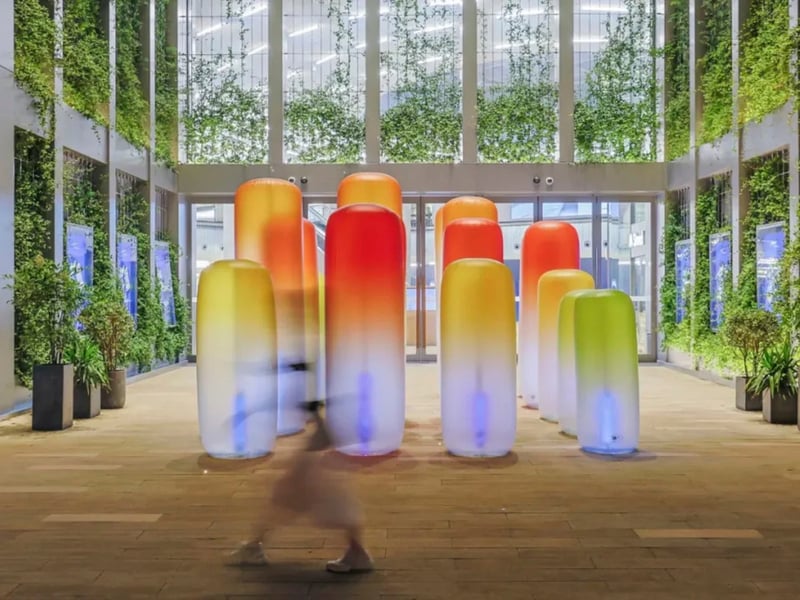
The Light Me UP! is an immersive installation by SHUOKE that recreates an artificial ocean environment using large inflatable forms installed at Xintiandi Style II in Shanghai. The structures resemble coral and sea organisms, with gradient surfaces and internal lighting that pulses in slow, breathing rhythms. Each column reacts to physical contact, producing subtle light shifts that simulate a living response. The experience is designed to feel reciprocal, where movement and touch trigger visible changes in the environment.
The system is programmed with a threshold that alters its behavior based on interaction intensity. Gentle movement activates light and motion, while excessive force causes the illumination to fade and the installation to dim. This response models ecological imbalance through physical interaction, translating environmental sensitivity into a tactile experience. Inflatable materials were selected for their softness and responsiveness.
Image Credit: Shuoke
What Makes This Trend Stand Out
- Responsive Soft Architecture
- Adaptive inflatable forms combined with embedded sensors and actuators present possibilities for environments that physically deform and illuminate in response to human presence, shifting expectations for temporary and reconfigurable spaces.
- Biomorphic Light Interactivity
- Gradient, organism-like illumination that changes with touch introduces novel paradigms for ambient communication where lighting behaves as a perceivable collaborator rather than a passive fixture.
- Ecological Feedback Design
- Designs that modulate behavior based on interaction intensity create opportunities for installations that embody environmental sensitivity, translating human activity into perceivable ecological consequences.
Sectors Adopting This
- Retail Experience Design
- Sensor-enabled inflatable installations could transform storefronts and in-store activations into soft, reactive stages that alter shopper perception of brand intimacy and novelty.
- Public Art and Placemaking
- Large-scale interactive oceanic sculptures offer new frameworks for civic engagement and tourism by turning communal spaces into adaptive narratives that reflect crowd behavior and environmental themes.
- Therapeutic and Wellness Spaces
- Soft, breathing structures with tactile-responsive lighting suggest environments that support sensory modulation and patient-centered calming experiences in clinical and wellness settings.