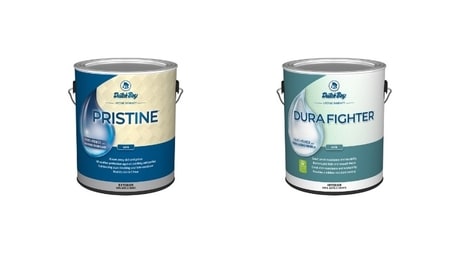
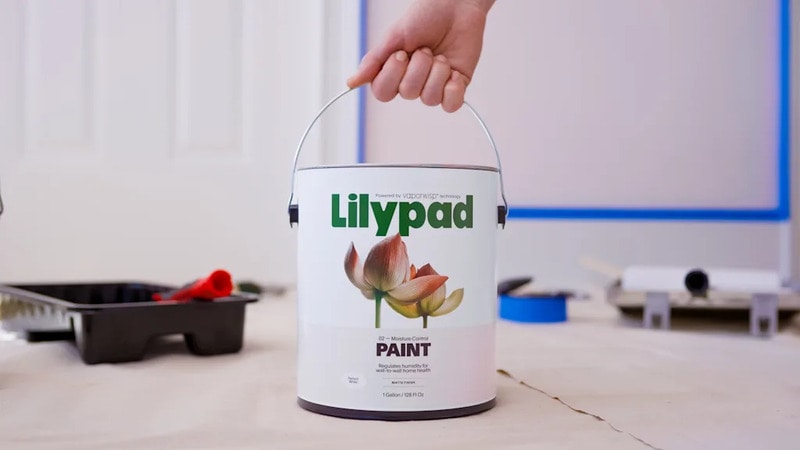
Adept Materials has launched Lilypad, a humidity-regulating paint and primer system that actively absorbs, stores, and releases water vapor to smooth out indoor moisture fluctuations without requiring any electricity, sensors, or mechanical components. The technology, which originated from physics research at Brown University, functions by embedding a desiccant-like capability directly into the coating. This, in turn, allows a single gallon of the humidity-regulating paint to capture roughly the equivalent of the steam produced by a hot shower and then gradually release that moisture back into the air as the environment dries. The accompanying primer acts as a responsive barrier that limits vapor migration into wall cavities when ambient humidity is low.
For homeowners who have battled persistent condensation on windows, recurring mildew in bathrooms, or that faint damp smell in basements and closets, Lilypad offers a preventative strategy that operates continuously and invisibly.
Image Credit: Adept Materials
What Makes This Trend Stand Out
- Passive Moisture-buffering Coatings
- Coatings that absorb and re-release water vapor create envelopes that stabilize indoor humidity profiles without electronics, enabling rethinking of moisture management in sealed buildings.
- Sensorless Indoor Climate Regulation
- Humidity-responsive materials embedded in finishes provide continuous microclimate moderation, reducing reliance on sensor networks and active control systems for routine moisture swings.
- Functionalized Building Materials
- Layered primers and paints with sorptive chemistries turn ordinary surfaces into active environmental components, blurring lines between finishes and building systems.
Sectors Adopting This
- Residential Construction
- New-home specifications that include humidity-regulating finishes could shift design standards by lowering condensation risks in bathrooms, basements, and tight building assemblies.
- HVAC and Building Services
- Climate-control service models may evolve as passive moisture buffering reduces short-term demand fluctuations and creates opportunities for smaller mechanical systems.
- Mold Remediation and Preservation
- Treatment and preservation strategies for moisture-damaged structures may incorporate sorptive coatings to limit recurring mildew and protect sensitive materials over time.