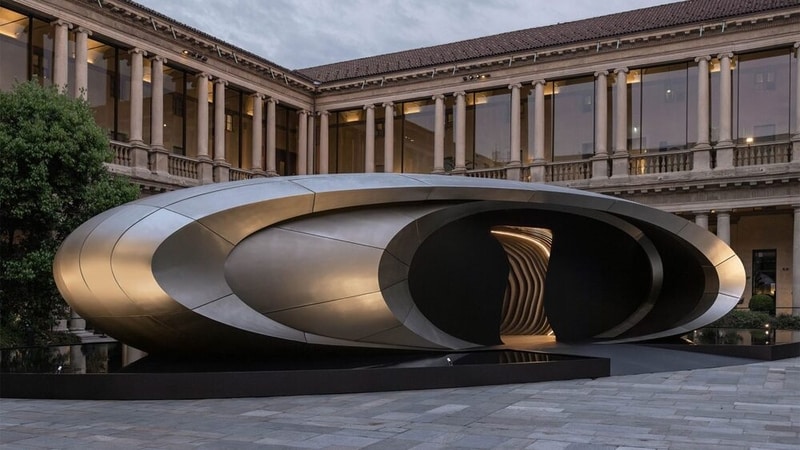
Audi Origin by Zaha Hadid Architects is an immersive installation presented at Milan Design Week 2026, located within the courtyard of Portrait Milano on Corso Venezia. The project takes the form of a titanium-toned fibreglass portal positioned above a reflective surface, creating a sculptural threshold that interacts with its historic surroundings. Designed as a spatial sequence, the structure uses compression and expansion to guide movement while framing views through its curved geometry.
The installation evolves throughout the day as light, shadow, and reflection shift across its surfaces, revealing changing visual conditions as visitors move around and through the structure. Developed as an interpretation of Audi’s design principles, the project emphasizes reduction and clarity by stripping away excess form to focus on material, proportion, and spatial experience. The result is a continuously changing environment shaped by reflection, movement, and the surrounding architectural context.
Image Credit: Audi, Antonis Hadjimichael
Why This Trend Is Growing
- Reflective Spatial Installations
- Sites that leverage mirrored surfaces and water-like reflections to multiply perspectives and create immersive, ephemeral environments for visitors.
- Dynamic Light-responsive Architecture
- Structures designed to change visual and spatial character over the day by harnessing natural and engineered light to modulate user experience.
- Material Minimalism in Brand Experiences
- Brand-led environments that prioritize reduced form, precise proportions, and refined materials to communicate identity through subtle spatial choreography.
Industries Being Reshaped
- Automotive Design
- Automotive firms exploring sculptural, experiential installations as extensions of vehicle aesthetics and brand narratives for customer engagement.
- Cultural Tourism and Museums
- Exhibition venues and cultural districts incorporating temporally shifting installations to attract repeat visitation and reinterpret historic contexts.
- Urban Placemaking and Real Estate
- Developers and city planners integrating reflective, light-responsive portals and plazas to redefine public thresholds and pedestrian flow.