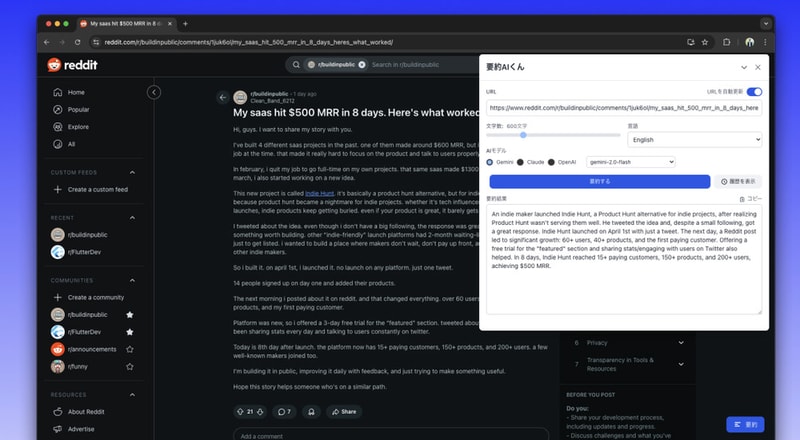
Summarization AI is a productivity tool designed to quickly condense web content into shorter, customizable summaries. Users can input a webpage URL and select preferred output length, language, and underlying AI model, enabling flexible content processing based on individual needs.
The platform supports multiple AI systems and offers translation capabilities, allowing summaries to be generated or converted across languages such as English and Japanese. Additional features include automatic URL detection, one-click copying or sharing, and the ability to store or export summary histories as CSV files. From a business perspective, the tool reflects increasing demand for information efficiency, particularly in environments where professionals must process large volumes of online material quickly. By simplifying content review and overcoming language barriers, Summarization AI supports faster research, knowledge management, and decision-making workflows.
Image Credit: Summarization AI
What Makes This Trend Stand Out
- Real-time Multilingual Summarization
- Instant translation and condensation of web content across languages creates potential for platforms that unify cross-border research and multilingual customer insights.
- Model-agnostic Summarization Platforms
- Support for multiple underlying AI models enables interoperable services that let users balance cost, accuracy, and latency depending on task criticality.
- Summary-as-knowledge-export
- Exportable summary histories and CSV archives open possibilities for downstream analytics and automated knowledge-bases built from condensed web data.
Sectors Adopting This
- Legal Research
- Condensed, translated case law and regulatory summaries could reshape how legal teams perform due diligence and prepare briefs across jurisdictions.
- Financial Services
- Rapid summarization of market news and translated reports offers pathways for faster trading signal generation and cross-market intelligence.
- Enterprise Knowledge Management
- Aggregated summaries and exportable histories suggest new models for internal knowledge graphs and searchable corporate memory systems.