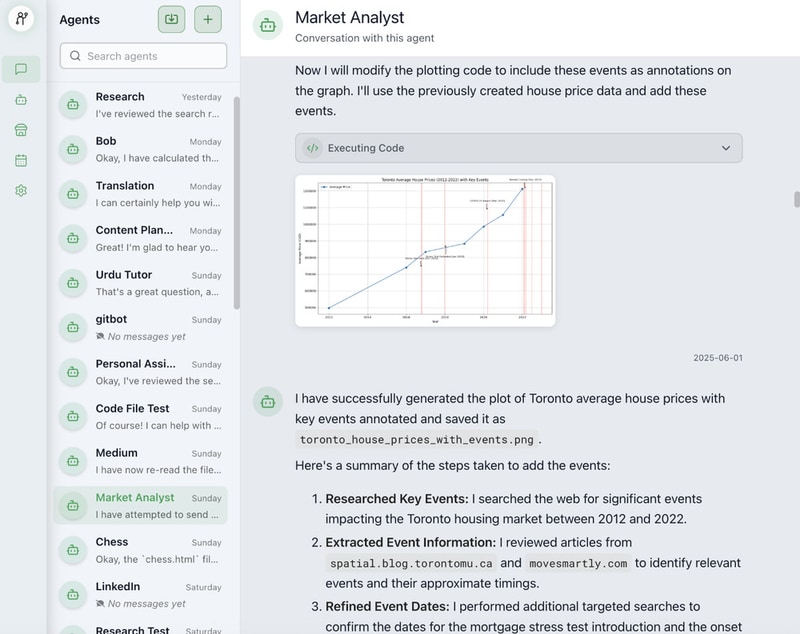
Local Operator is an open-source platform that enables users to run multiple AI agents directly on their own device. These agents are designed to operate collaboratively, communicating with one another and delegating tasks based on defined roles or areas of expertise.
The system incorporates conversational learning and memory, allowing agents to retain context and improve performance over time. It is intended to support workflows where tasks can be distributed across specialised agents, reducing the need for manual coordination. Because it runs locally, the platform offers greater control over data and execution compared to cloud-based alternatives. Local Operator is typically used by developers, researchers, and technically inclined users exploring multi-agent systems. It reflects broader developments in AI architecture, where decentralised, cooperative agents are used to manage complex processes and automate multi-step workflows.
Image Credit: Local Operator
Why This Trend Is Growing
- On-device Collaborative Agents
- Local execution of multiple cooperative agents with role-based delegation reduces dependence on cloud orchestration and alters trust and latency economics.
- Agent Memory and Conversational Learning
- Persistent contextual memory and conversational learning among agents improve task continuity and create new expectations for adaptive, long-lived AI behaviors.
- Decentralized Multi-agent Orchestration
- Distributed orchestration of specialized agents enables modular workflow decomposition that can upend centralized pipeline and automation models.
Industries Being Reshaped
- Enterprise Software
- Embedded multi-agent platforms on employee devices shift control over data flows and workflow automation from centralized SaaS vendors to localized, customizable systems.
- Healthcare
- Locally run collaborative agents with secure memory offer a model for patient-centric diagnostics and care coordination that reduces exposure of sensitive records to external clouds.
- Industrial Automation
- Edge-resident agent teams capable of retaining operational context present opportunities to replace monolithic control systems with resilient, task-specific agent networks.