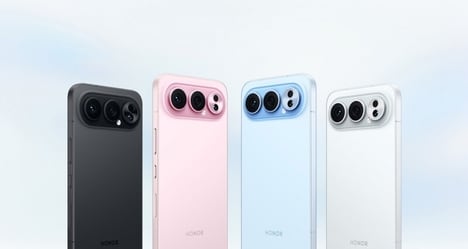

Honor unveiled the Magic V6, a new foldable phone built with motorsport-grade materials, features a silicon nitride screen coating and a reworked internal layout to host an unusually large battery. The device was shown at MWC 2026 and emphasizes mechanical durability alongside thinness, with a hinge engineered to automotive standards.
Honor designed the V6 around a 6,660mAh silicon-carbon cell for global units and a 7,000mAh-plus Blade Battery variant for China, both achieved by reshuffling speakers, ports and modules to make space. The hinge is rated for 500,000 cycles and the phone packs a 64MP periscope while keeping a flagship slim profile.
For consumers this product blends extreme durability and extended runtime in a foldable format, addressing two common trade-offs: fragility and battery life. By borrowing materials and architectures from racing and EVs, the Magic V6 signals a trend toward industrial-grade engineering in mainstream mobile devices.
Image Credit: Honor
What Makes This Trend Stand Out
- Motorsport-grade Materials in Consumer Devices
- Integration of racing-derived composites and coatings into smartphones creates opportunities for consumer products that combine high strength with reduced weight and premium durability.
- Silicon-carbon Battery Adoption
- A shift toward silicon-carbon cell chemistries in portable electronics points to new device architectures that prioritize much higher energy density and longer cycle life within constrained form factors.
- Automotive-standard Hinges for Portables
- Applying hinge engineering and lifecycle testing from the automotive sector enables foldable designs that significantly extend mechanical longevity while maintaining slim profiles.
Sectors Adopting This
- Mobile Handsets
- Smartphone manufacturers stand to redefine flagship differentiation by embedding industrial-grade materials and large-format batteries to overcome traditional trade-offs between durability and runtime.
- Electric Vehicles and Energy Storage
- Battery firms and EV makers could leverage silicon-carbon cell innovations demonstrated in handsets to develop denser, more compact modules for range improvement and packaging flexibility.
- Wearables and Rugged Electronics
- Producers of wearables and field equipment may adopt motorsport coatings and automotive-grade mechanical components to deliver longer-lasting, high-performance products for harsh environments.