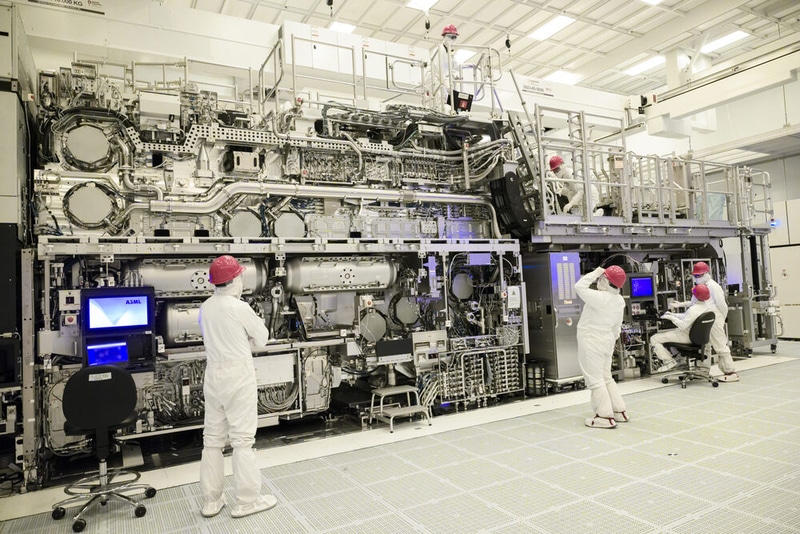
ASML unveiled its next-generation High-NA EUV lithography tools as production-ready after processing 500,000 wafers with roughly 80% uptime, featuring imaging precision intended to replace multiple patterning steps. The announcement identified TSMC and Intel as named adopters and set expectations for manufacturing integration timelines.
The systems cost about US$400 million each—roughly double prior EUV units—and ASML said targets include 90% uptime by year-end. TSMC has tested systems but may delay mass deployment, while Intel is further along in integrating High-NA into its 14A roadmap; full fab integration was framed as a two-to-three-year process.
For chipmakers and AI hardware customers, High-NA promises denser patterning and fewer process steps, which could lower complexity even as capital intensity rises. Adoption choices in Asia will shape AI chip supply economics and competitive positioning across foundries and IDM players.
Image Credit: ASML
Why This Trend Is Growing
- High-na Adoption Acceleration
- Promises replacement of multiple patterning steps with single-exposure precision, enabling denser transistor layouts and new process node economics.
- Capital Intensity and Cost Consolidation
- Represents a steep increase in per-tool investment that could concentrate advanced manufacturing capability among a smaller set of deep-pocketed foundries and IDMs.
- Regional Deployment Divergence
- Signals that staggered adoption across Asia and other regions will reshape supply economics for AI chips and create geographic advantages for early integrators.
Industries Being Reshaped
- Semiconductor Foundries
- Standards and throughput of High-NA tools are poised to redefine competitive differentiation through node leadership and yield efficiency.
- AI Hardware and Accelerators
- Denser patterning and fewer process steps are likely to support higher compute-per-area designs and tighter integration of accelerator fabrics.
- Capital Equipment and Metrology
- Demand for ultra-precise imaging and uptime optimization creates opportunities for next-generation metrology, maintenance platforms, and tool-level analytics.