



Greg Ponesse — May 18, 2006 — Tech
References: web-japan.org
The rice-planting robot (National Agricultural Research Center of the National Agriculture and Bio-oriented Research Organization)
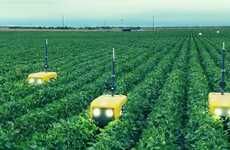
Rice is the staple food in Japan, and the planting of rice seedlings has been a backbreaking, yet essential, job since ancient times. Farmers must spend long hours stooping over muddy paddies inserting the seedlings one at a time. The job requires long experience and well-honed skills. Now, a group of scientists is working on a project that would hand the delicate task of inserting rice seedlings into paddies over to robots.
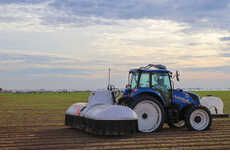
Mechanization was first introduced to rice farming in the late 1800s, although with limited success. Riding-type planters, now the most common planting machines, evolved from the human-powered planters that appeared in the 1960s. But the robot being developed by scientists at the National Agricultural Research Center of the National Agriculture and Bio-oriented Research Organization is light-years ahead of these, technologically speaking.
Researchers conducted trials in Saitama Prefecture in April 2005 in which the robot planted a rice paddy without any human intervention. To find its way around, the device relies on the global positional system (GPS), which is also used in car navigation devices. Tilt sensors and other instruments calculate the angle and direction of the machine's movements, which are computer controlled, so that the robot has a precise understanding of its position in the paddy.
Rice is the staple food in Japan, and the planting of rice seedlings has been a backbreaking, yet essential, job since ancient times. Farmers must spend long hours stooping over muddy paddies inserting the seedlings one at a time. The job requires long experience and well-honed skills. Now, a group of scientists is working on a project that would hand the delicate task of inserting rice seedlings into paddies over to robots.
Mechanization was first introduced to rice farming in the late 1800s, although with limited success. Riding-type planters, now the most common planting machines, evolved from the human-powered planters that appeared in the 1960s. But the robot being developed by scientists at the National Agricultural Research Center of the National Agriculture and Bio-oriented Research Organization is light-years ahead of these, technologically speaking.
Researchers conducted trials in Saitama Prefecture in April 2005 in which the robot planted a rice paddy without any human intervention. To find its way around, the device relies on the global positional system (GPS), which is also used in car navigation devices. Tilt sensors and other instruments calculate the angle and direction of the machine's movements, which are computer controlled, so that the robot has a precise understanding of its position in the paddy.
Trend Themes
1. Robotic Agriculture - Developing robots to carry out essential yet physically demanding farming tasks allows for agricultural industries to increase productivity and relieve farmers' burdens.
2. GPS Navigation - Integrating GPS technology to navigate robotic machines can result in more efficient and precise farming practices.
3. Automated Planting - Automating the process of planting rice seedlings can potentially reduce labor costs and increase crop yield.
Industry Implications
1. Agriculture - Incorporating robotic technology into farming practices can lead to increased efficiency and productivity for agricultural industries.
2. Robotics - Developing robots for delicate and physically demanding tasks continues to be a growing area of innovation and investment for the robotics industry.
3. GPS Technology - There is an opportunity for the GPS industry to expand their market within the agricultural sector by developing more advanced and precise navigation systems for farming robots.
4.2
Score
Popularity
Activity
Freshness